
WHITE LED lash extensions lamp 5W

250.00 €

WHITE LED-UV LAMP, 5 W (white light)

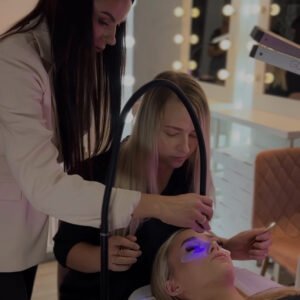
Minimalist NEW 5 W lamp with a WHITE, visually neutral glow (not a "blue" tint). Stable light beam, convenient for precision beauty treatments requiring focused lighting or photoinitiator activation in the 400–420 nm range.

Why it's exceptional

  • White light – a more comfortable, neutral visual experience while working (no violet/blue “glow”).

  • 5 W power – sufficient for compact, precise illumination close to the working area.

  • Constant emission – reliable performance.

Specifications

  • Power: 5 W

  • Light type: white (phosphor-converted LED), featuring a ~400–450 nm component

  • Intended use: directional illumination, photoinitiator activation (e.g., in the ~405 nm range), improving work area visibility


Scientifically: "blue UV LED" vs "white LED" (spectrum, nm, effect on the eye, EM spectrum)

How "white LED" light is produced
Most often – a blue/violet LED (about 450±20 nm or ~405 nm) with phosphor: the blue peak remains, while the phosphor "spreads" a broader spectrum toward green-red, making it appear white to the eye. In practice, "white LED" still contains a significant short-wavelength (blue/violet) component.

Typical “blue/UV LED”
Narrower peak ~400–410–450 nm (common photoinitiator activation range). Although 400–405 nm appears violet/“blue” to the human eye, it is still the borderline region of near-UV / low-nm visible light.

Effect on the eye (safety rationale)

  • Retinal blue light hazard: photochemical risk is highest in the ~435–440 nm range; it depends on radiance and exposure duration. The IEC 62471 standard defines risk groups and evaluation methods (RG0–RG3), while ICNIRP guidelines provide the spectral weighting function for the "blue-light hazard". Conclusion: do not look directly at the source, limit distance/time, and use 400–420 nm protective safety glasses. aiha-assets.sfo2.digitaloceanspaces.com+3Smart Vision Lights+3instrumentsystems.com+3

Quick summary: Blue (405–450 nm) vs White (broad spectrum)

  • Spectrum: blue – narrow peak (~405–450 nm); white – broad (including blue/violet spectrum). Appearance: blue/violet glow; white – neutral, rendering colors more naturally.

  • Eye risk: both have a shortwave component that determines blue-light weighting; risk depends on source brightness, distance, and exposure duration – which is why we follow IEC 62471/ICNIRP guidelines.


Safe use (recommendations)

  • Do not look directly into the LED source, especially up close and for extended periods.

  • Use protective safety glasses that filter the 400–420 nm range if working in very close proximity to the light source.

  • Maintain distance and limit exposure time in accordance with photobiological safety principles (IEC 62471). Smart Vision Lights

__

Safety glasses are included in the kit

Adjustable light spectrum size and power. Can be switched on with a button or a foot pedal.

Adhesive is sold separately in the e-shop 😉

I invite you to learn this innovative art of lash extensions 😉
Link and info here:

https://alashes.lt/ledlashes/
____

__
We provide more info individually 🙂
____
https://www.youtube.com/watch?v=78sDoU3q_pU

Here you can discover the LED technique 🙂
___

4 in stock

Hurry, only 4 left!

WHITE LED-UV LAMP, 5 W (white light)

Minimalist NEW 5 W lamp with a WHITE, visually neutral glow (not a "blue" tint). Stable light beam, convenient for precision beauty treatments requiring focused lighting or photoinitiator activation in the 400–420 nm range.

Why it's exceptional

  • White light – a more comfortable, neutral visual experience while working (no violet/blue “glow”).

  • 5 W power – sufficient for compact, precise illumination close to the working area.

  • Constant emission – reliable performance.

Specifications

  • Power: 5 W

  • Light type: white (phosphor-converted LED), featuring a ~400–450 nm component

  • Intended use: directional illumination, photoinitiator activation (e.g., in the ~405 nm range), improving work area visibility


Scientifically: "blue UV LED" vs "white LED" (spectrum, nm, effect on the eye, EM spectrum)

How "white LED" light is produced
Most often – a blue/violet LED (about 450±20 nm or ~405 nm) with phosphor: the blue peak remains, while the phosphor "spreads" a broader spectrum toward green-red, making it appear white to the eye. In practice, "white LED" still contains a significant short-wavelength (blue/violet) component.

Typical “blue/UV LED”
Narrower peak ~400–410–450 nm (common photoinitiator activation range). Although 400–405 nm appears violet/“blue” to the human eye, it is still the borderline region of near-UV / low-nm visible light.

Effect on the eye (safety rationale)

  • Retinal blue light hazard: photochemical risk is highest in the ~435–440 nm range; it depends on radiance and exposure duration. The IEC 62471 standard defines risk groups and evaluation methods (RG0–RG3), while ICNIRP guidelines provide the spectral weighting function for the "blue-light hazard". Conclusion: do not look directly at the source, limit distance/time, and use 400–420 nm protective safety glasses. aiha-assets.sfo2.digitaloceanspaces.com+3Smart Vision Lights+3instrumentsystems.com+3

Quick summary: Blue (405–450 nm) vs White (broad spectrum)

  • Spectrum: blue – narrow peak (~405–450 nm); white – broad (including blue/violet spectrum). Appearance: blue/violet glow; white – neutral, rendering colors more naturally.

  • Eye risk: both have a shortwave component that determines blue-light weighting; risk depends on source brightness, distance, and exposure duration – which is why we follow IEC 62471/ICNIRP guidelines.


Safe use (recommendations)

  • Do not look directly into the LED source, especially up close and for extended periods.

  • Use protective safety glasses that filter the 400–420 nm range if working in very close proximity to the light source.

  • Maintain distance and limit exposure time in accordance with photobiological safety principles (IEC 62471). Smart Vision Lights

__

Safety glasses are included in the kit.
Additional information

Length

MIX (8-12)

Curl

CC, D

Thickness

0.07mm

Reviews

There are no reviews yet.

Only logged in customers who have purchased this product may leave a review.